Real-World Task Guidelines:
Stage I
CLB 3
Home and Neighbourhood
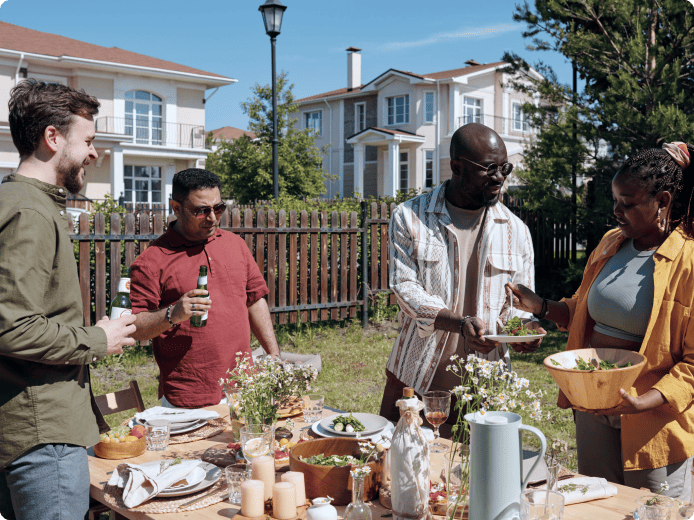
Possible Topics
This theme may include these topic areas:
And so on
Planning Context
Learners may require the following:
- Slow to normal rates of speech
- Face-to-face or digital interactions (that are usually one-on-one or in small groups)
- Topics related to personal relevance
- Non-demanding contexts
- Relatively short texts
Instructors may need to:
- Create simplified versions of rental websites
- Create navigation guides for websites
- Adapt resources to simplify social interactions
- Modify instructions to limit to 2 to 4 steps
- Speak clearly at a slow to normal rate
Comprehending Instructions
Understands instructions and directions related to familiar, everyday situations of immediate personal relevance.
- Identifies words and phrases that indicate movement, location, measurement, weight, amount and size.
- Responds with correct actions to directions and instructions.
Comprehending Information
Understand short, simple, descriptive communication about a situation.
- Gets the gist.
- Identifies factual details, key words and expressions as required.
Interacting with Others
Use a range of courtesy formulas and greetings in very short, casual, face-to-face interactions.
- Uses appropriate polite expressions.
- Uses simple sentences and question formations.
Getting Things Done
Make and respond to an expanding range of simple requests related to everyday activities. Make and respond to an expanding range of simple requests related to everyday activities.
- Uses simple sentences and question formations.
- Repeats and attempts to explain when necessary.
Interacting with Others
Understand short, personal messages within predictable contexts of daily experience.
- Gets the gist.
- Identifies some specific details and information (such as sender, date, and response required).
Getting Things Done
Get information from short business or service texts.
- Gets overall meaning.
- Scans formatted text to find specific information.
Getting Things Done
Get information from short business or service texts.
- Gets overall meaning.
- Interprets simple graphics.
Sharing Information
Write a few sentences to describe a familiar place.
- Uses a few connected sentences.
- Provides adequate descriptions, though a reader may have some difficulty following the message.
Getting Things Done
Write short, simple business messages.
- Conveys the message, although a reader might have some difficulty following.
- Uses language and content that are appropriate to the intent and social context.
Reproducing Information
Copy or record a range of information from short texts for personal use.
- Copies or records letters, numbers, words and sentences with correct capitalization and punctuation.
- Copies text legibly; causing only slight uncertainty in decoding for the reader.
- Copies with no major omissions and only occasional copying mistakes.
Additional Sample Real-World Tasks and Competency Areas
Listen to a brief description of a rental listing and determine whether it is a good place to live. (Comprehending information)
Give some short, simple instructions to a neighbour who is checking on your house while you are away. (Giving instructions)
Read information from your landlord about changes to parking rules. (Comprehending information)
Copy instructions for how to recycle specific items from a website. (Reproducing information)
Additional Resources
Digital Literacy Strategies
Successful completion of some tasks may require some baseline digital knowledge and skills.
Learners may need to:
- Locate, navigate and use websites.
- Scan online resources to find information.
Instructors can:
- Support learners in finding, navigating and using websites.
- Teach reading strategies such as skimming and scanning to find information on websites.


Equity, Diversity and Inclusion Strategies
Instructors Can:
- Use diverse representations of people in all your learning resources and images, including people who are 2SLGBTQIA+, Indigenous, Francophone and of other cultures, and people who have disabilities or who are neurodivergent.
Trauma-Informed Strategies
Triggers:
- Learners who have experienced trauma can be triggered by people in positions of authority; make sure learners understand their rights in relation to landlords and housing authorities and give strategies for making polite requests.
Strategies:
- Recognize that not everyone will feel comfortable with the idea of meeting previously unknown neighbours; adapt tasks to meet “safer” people such as classmates or other teachers as needed.
- Giving learners the knowledge, skills and language to access resources can be empowering.

Sample Real World Tasks
This information is aligned with the Canadian Language Benchmarks (CLB) and is designed to help guide you in the planning process. You can use these sample real-world tasks to guide and inform your selection or creation of skill-building activities, skill-using tasks and assessment tasks.
These sample real-world tasks include the following: skill, real-world task, competency area, one competency statement and two sample indicators of ability. This is not an exhaustive list: there are more indicators of ability and information about this CLB level in Canadian Language Benchmarks English as a Second Language for Adults. Consult this resource for more information and to select your own competencies or indicators of ability. Remember, you can use more learner-friendly language in your materials and assessments.
This is NOT a lesson plan, module plan or curriculum.